Everything from the moment you receive your I-20 to the day you land — with a checklist for every step and the official source beside it.
Last reviewed November 2026 · Sources linked below · General information, not legal or financial advice
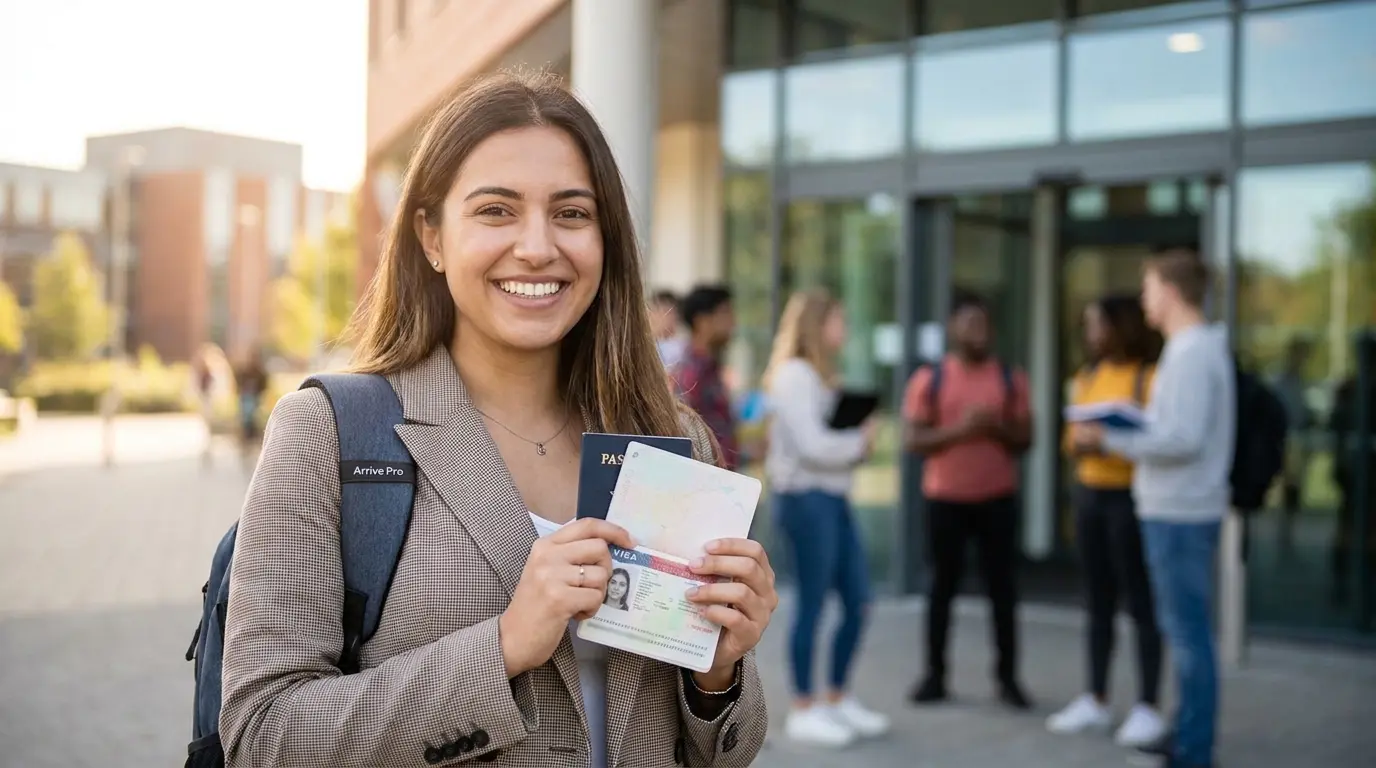
Figures as of November 2026 · Official source: US Department of State — Student Visa ↗
Your I-20 is issued by your university’s Designated School Official (DSO). You cannot apply for an F-1 visa without it.
If anything is wrong, contact your DSO for a corrected I-20 before paying the SEVIS fee.
The SEVIS fee is $350 for F-1 students. Pay online at fmjfee.com.
Print or screenshot your receipt. You'll need to present this at your visa interview — embassies do not look it up for you.
The DS-160 is the online nonimmigrant visa application. Complete it on the US Department of State website.
Pay the $185 visa application (MRV) fee, then book at the US embassy or consulate in the country where you live — applying elsewhere can make it harder to qualify. Applicants aged 14–79 generally need an in-person interview.
Bring originals of everything below and be ready to explain your program, your funding and your plans after graduating.
Student visas can be issued up to 365 days before your program starts, but you can’t enter the US more than 30 days before the start date on your I-20. Keep your key documents in your hand luggage — see the arrival day checklist.
Report to your international student office so your SEVIS record is activated, and download your I-94 arrival record from the CBP website.
Up to 20 hours a week while classes are in session, and full-time during official breaks.
Curricular Practical Training must be part of your curriculum and authorised by your DSO before you start.
Up to 12 months of work after your program, plus 24 more for eligible STEM degrees. You can apply up to 90 days before your program ends.
No more than 30 days before the program start date on your I-20. Arriving earlier risks being refused entry at the port of entry.
No. Your visa only needs to be valid when you enter the US. F-1 students are admitted for “duration of status” — you can stay as long as you keep your student status, plus 60 days after your program or OPT ends.
On campus, up to 20 hours a week during term and full-time during breaks. Off-campus work needs authorisation through CPT, OPT or STEM OPT.
Not yet. In October 2026 DHS proposed fees of $70,000 for initial OPT and $30,000 for later OPT. The comment period closed on 9 November 2026 and no final rule has been published.
You can reapply. Most F-1 refusals are under Section 214(b). Strengthen your evidence of funding and ties to your home country before you apply again.
Yes, with a valid passport, a valid F-1 visa and an I-20 with a DSO travel signature from the last 12 months. Re-entry is at the officer’s discretion.
Arrive organises your move. Governments and universities decide the rules.
Arrive gives you step-by-step guidance tailored to your university, visa type, and home country — all in one free app.
 Arrive